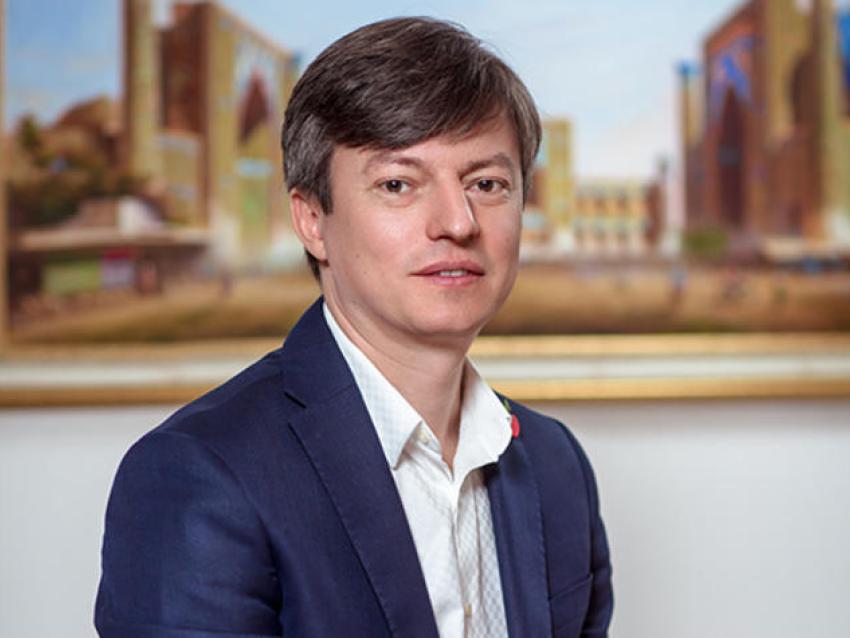
From Lexington to Almaty: UK MBA alum reshapes retail in Central Asia
LEXINGTON, Ky. (July 24, 2026) — When Dmitry Revin first walked into Fayette Mall in Lexington in the late 1990s, he saw more than a place to shop.
He saw a model for community.
“This did not exist in Central Asia,” Revin said. “It was the most exciting and memorable experience.”
There were department stores, a bookstore, restaurants and entertainment — all centered around the needs of customers.
“I especially remember Lazarus and JC Penny for fashion,” he recalled. “And the Fayette mall bookstore is where I bought my first audio book of Stephen Covey's, ‘7 habits of highly effective people.’”
For Revin, who grew up in Uzbekistan at a time when most shopping in Central Asia happened in bazaars and unorganized retail markets, the experience was unforgettable.
Years later, that early glimpse of American retail would help shape one of the most influential commercial developments in Central Asia.
Revin, a 2000 MBA graduate of the Gatton College of Business and Economics at the University of Kentucky, is co-founder of Aport Malls — Kazakhstan’s largest mall developments and chairman of the Union of Retail Property Developers of the Republic of Kazakhstan.
Aport Malls have become lifestyle destinations in the Almaty metropolitan area — drawing millions of visitors each year and helping accelerate the growth of modern retail in Kazakhstan.
Today, Aport Malls total more than 300,000 square meters, host more than 500 tenants — including more than 100 international brands — and attract nearly two million visitors each month, according to The Business Year. The developments have also been recognized as the Best Retail Development in Kazakhstan by the International Property Awards.
A global path to Kentucky
Revin was born in Tashkent, Uzbekistan, and graduated with honors from the University of World Economy and Diplomacy, where he specialized in international economic relations.
He began his career with Procter & Gamble in Central Asia and Mongolia — studying consumer behavior across Uzbekistan, Kazakhstan and other countries in the region.
That early work gave him a front-row seat to a changing retail landscape.
Three decades ago, he said, more than 95% of retail turnover in Central Asia happened through bazaars and unorganized retail. By 2026, organized retail in Kazakhstan had grown to about 45%.
His decision to pursue an MBA in the United States came with encouragement from his father, who pushed him to earn a graduate degree abroad. “I chose UK for its campus, the newly opened William T. Young Library, Lexington’s business environment and the climate of the Bluegrass state, which reminded me of Central Asia.”
It wasn’t long before Revin also found a welcoming community. “I found such friendly, nice people at UK,” he said. “It helped make Lexington feel like the right place.”
At Gatton College, Revin studied finance and management information systems. He credits those areas of study with giving him a cross-functional understanding of business — one that connected marketing, finance, development, information systems and customer experience.
He also remembers faculty members who left a lasting impression.
“Albert L. Lederer, professor of management information systems, once asked me whether I knew real estate would become the field that defined my career. At the time, I was focused on the internet and information systems. This changed my way of thinking,” Revin explained. “Another professor, who taught accounting, showed students how to build automated financial statements in Excel using practical case work.”
Those lessons stayed with him. “You cannot manage without information,” Revin said. “That’s where MIS comes in handy.”
Building during a crisis
After graduating from UK in 2000, Revin worked for Deloitte — helping develop management consulting operations in the Caspian region. He later co-founded Eurasia Real Estate Development Group with partners in 2007.
That strategy was tested almost immediately.
“When it comes to establishing and developing your own business you are much better positioned to make your ideas happen as you envision them,” Revin continued. “At the same time, you face more challenges, risks and uncertainty.”
The first Aport Mall was developed during the global financial crisis and opened in 2009, shortly after the collapse of Lehman Brothers. The project began on a greenfield site in an underdeveloped suburban area near Almaty — a location many doubted would attract shoppers.
At the time, commercial real estate professionals were scarce in the market, international retailers were limited and Kazakhstan’s retail sector was still dominated by bazaars.
Few people believed families would travel to a suburban development for shopping, entertainment, restaurants, sports and services.
Revin did.
“Crisis comes and goes,” he said. “But strong commitment and desire to provide modern infrastructure and world living standards for Almaty residents and guests helped the team move forward.”
The first phase of Aport Mall opened Sept. 20, 2009, with 75% occupancy — after an intense nine-month push to build an in-house leasing and development team. Revin knew the team had little choice but to succeed.
“Mission impossible made possible by smart, hard work and no way back,” he said.
More than shopping
From the beginning, Revin envisioned Aport as more than a shopping center.
He was drawn to the idea of the mall as a “third place” — after home and work — where people could gather, eat, exercise, be entertained and spend time with family.
That concept became central to development.
Aport created and expanded lifestyle and entertainment formats, including Funky Town, Funky World, Funky Planet, Hawaii Aquapark, Hawaii Fitness, Miami Resort & Spa, HALYK IMAX Kinopark 16 and San Remo Resort & Spa. Together, those formats have welcomed more than 150 million guests since 2009.
For Revin, the goal has always been to build around people. “Human life is not just about shopping,” he said. “It’s entertainment, food, sport, joy and socializing.”
That approach has helped make Aport Malls growth centers for western and northeastern Almaty. The developments have created 10,000 jobs in the region, attracted more than 500 tenants and helped bring major international brands to Kazakhstan and Central Asia.
“Most important is that Almaty metropolitan residents and guests, especially women and children, get modern retail, entertainment, service concepts, sport facilities, food formats and the best lifestyle experience,” Revin said.
Lessons that lasted
As Aport grew, Revin continued to draw on lessons from UK — especially the importance of team development and lifelong learning.
Because there were few experienced commercial real estate professionals in Almaty when Aport began, Revin focused on hiring and growing talent from within. Employees read professional books, presented ideas, discussed applications and took part in tenant internships. Team members were trained in mall operations, customer experience and retail strategy.
He calls the process a “learning organization” model.
Since 2007, Revin said, more than four generations of Aport team members have been trained. Some have gone on to lead retail brands, create consulting practices and develop other malls across Central Asia.
“Education is light, knowledge is power, application is might,” he said.
The next chapter
Revin’s work is now focused on larger district development projects centered around infrastructure, access and quality of life.
He is particularly interested in the “15-minute city” concept — communities where residents can reach daily needs, services and amenities within a short walk, bike ride or drive.
“What excites me is that you influence people’s lives for the best,” he said. “And bring best world practices and living standards alive locally.”
Revin is also in the process of writing a book, “Central Asia: Decades of Development,” to share lessons from the region’s growth and his experience building businesses across countries.
As he reflects on his journey from UK student to international developer, Revin’s advice for current students is direct.
“Dream big,” he said. “Work smart and hard to achieve your goals. Take into account best worldwide practices, but always account for local peculiarities, in particular your customer needs.”
He also encourages students to travel, build relationships with global leaders and seek international internships — especially in emerging markets.
For Revin, being a UK alum remains a source of gratitude.
“Heritage and gratitude to the Carol Martin Gatton College of Business and Economics at the University of Kentucky,” he said. “Thanks a lot to the nice people and my friends there — and you are always welcome to Almaty, Tashkent and Central Asia.”