Plan Your Experience
Start Your Planning TODAY!
Start Your Planning Today!
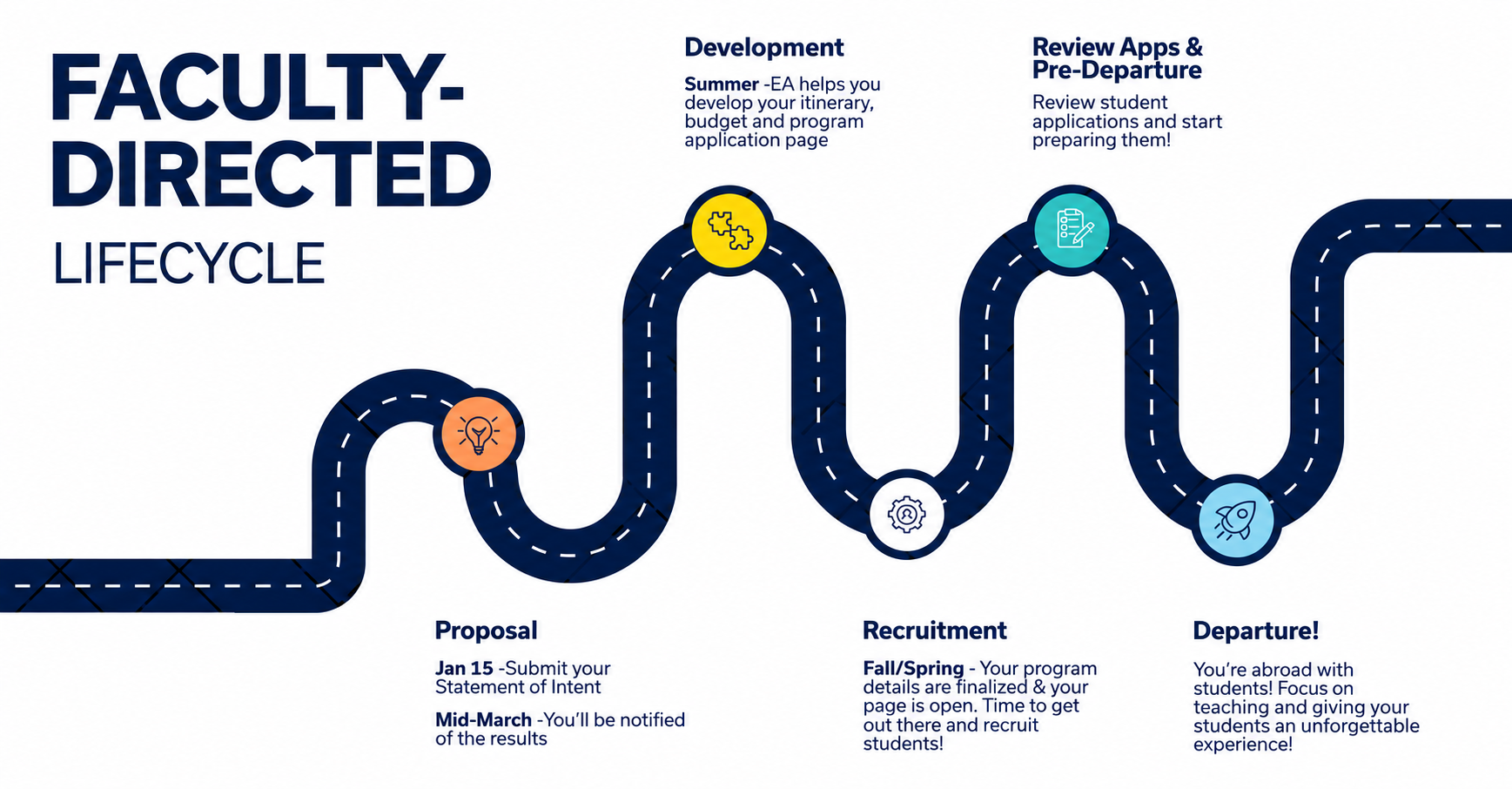
Programs can take up to a year to fully develop. There are a lot of moving parts; the first step is the Statement of Intent (SOI) process.
This process happens once a year for faculty to propose programs. These are reviewed and approved by different bodies, including your department/college leadership and the Education Abroad Committee (EAC), a faculty committee comprising past and present program directors and other UK leadership.
SOIs are:
- Outlines of the program - Think of this as a rough draft that shows the academic objectives, goals, and reasons for the program.
- Able to connect the academics with the location - Answer why you need to take students to this location instead of learning it on campus.
- Enough information to create a vision and tie the program to your college's and university's goals or priorities.
- Road map on how your program fits with students' needs and marketing considerations.
SOIs are NOT:
- A fully developed program with all parts locked in.
- A guarantee that the program will be approved for development.

Planning a faculty-directed program for the first time? Click here to submit a new program proposal.
Note: Use the new program application if this is your first time proposing the program, if it has not gone abroad in the past 2 years, or if you are making major changes to its location, courses, leaders, or timing.
Returning faculty who want to offer a program again can click here to apply for a recurring program.
Note: Recurring program applications are for programs that have successfully gone abroad once in the past 2 years with no major changes- same location, same courses, same leaders, same time. For all other applications, please use “new.”
What goes into a program proposal/planning?
Location
Choosing the location to teach your course is very important. What academic experiences can your students have in this country that are not available back home? Is this a country that your students will be excited about? You don’t have to pick a country in which you have experience, but it does help.
Timing
Think about the time abroad needed for your course and your students. Consider which model of programming - embedded or standalone - will best fit the program’s needs. Also, keep in mind your students' schedules; different times of the year can interfere with internship options, work schedules, and family commitments.
Academic Elements
You will decide, with your department’s approval, how the course and contact hours are delivered for your program. Contact hours can be achieved in a variety of ways (classroom time, during program activities, guest lectures, online before and after program, etc.). Some models allow you to offer more than one course. 3 credits generally mean 45 contact hours. Helpful tip - choose popular courses that your students want/need!
Cultural Elements
Cultural activities allow students to understand the local environment and develop intercultural competence. Examples include: cooking class, city tours, museums, local landmarks, etc. It is ok if you don’t know all of these elements; that is a big part of using a program provider- they can offer suggestions!
Budget
You and your Faculty-Directed Coordinator will build a program budget. Leaders are compensated for their work, but it might not be the same as in a normal course (see Standard Compensation Policy). Students are charged a program expense cost + some tuition for their program. Program budgets are not meant to make revenue- what comes in, goes out. Once we advertise an amount on the program page, we CANNOT charge the students anything more.
Audience/Marketability
When putting your program proposal together, think about your audience (AKA students). What course will appeal to the greatest number of students? Can students from other majors/minors take that course? Is your program location attractive to students? You will be the face of the program, so make sure that you have time and capacity to commit to recruiting.
SOI checklist
- Start an application - they should open on or around November 1st
- Check with your department about courses, other program plans, and seek approval to move forward (this is important)
- Set up a meeting with the Faculty-Directed Team as needed
- Attend an online SOI 101 Session or the Learning Bites in-person event if able
- Complete the application before the deadline- applications lock at 11:59 pm EST on January 15th
SOIs may not be approved for development when…
- There is not enough information. Include enough detail for reviewers to understand the proposed learning experience and how the program will come together. Even if some elements are still tentative, share what you envision.
- The connection to the location is unclear. Explain why students need to be in this particular location to engage meaningfully with the topic. What can they learn or experience there that they cannot learn on campus?
- The target audience or demand is unclear. Be specific about who the program is designed for and, when possible, use enrollment data, student interest, or other evidence to demonstrate demand. An interesting topic is not enough if there may not be enough students interested in participating.
- The program does not align with departmental or institutional goals. While alignment is not always required, connecting your program to existing priorities or strategic goals can strengthen your proposal.
- The program is too similar to existing or proposed programs. Programs with overlapping locations or academic themes may compete for the same students. Consider how your program can offer a distinct experience, or explore partnering with other faculty to combine programs or create a rotation of opportunities.